Wood Vinegar Boosts Wheat and Maize Yields on Saline Soils While Improving Nitrogen Use Efficiency — Two-Year Field Evidence

Wheat and maize growers farming saline or alkaline soils have new research to consider — a two-year field trial published in the Journal of Soil Science and Plant Nutrition found that wood vinegar applied as a foliar spray increased wheat yields by 12.4 to 44.3% and maize yields by 6.8 to 13.7% in a saline-alkali cropping system. The research also found wood vinegar enhanced fertiliser efficiency, with nitrogen utilisation significantly improving when wood vinegar was combined with urea humate.

The trial was conducted over two consecutive seasons on saline-alkali soils using a wheat-maize rotation — one of the most common broadacre cropping systems. Seven treatments were tested, combining three rates of urea humate (none, 50%, and 100%) with and without foliar wood vinegar applied at 90 litres per hectare. A no-nitrogen control was included as a baseline.

The yield results were notable. Wood vinegar applied alone — without urea humate — produced wheat yield increases of 12.4 to 44.3% depending on the season. Maize yields increased by 6.8 to 13.7%. When wood vinegar was combined with urea humate, nitrogen use efficiency improved significantly relative to urea humate alone, pointing to a synergistic effect between the two inputs.

The soil biology findings were equally significant. Compared to the no-urea-humate treatment, microbial biomass carbon increased by 9.8 to 24.9% and microbial biomass nitrogen by 18.1 to 29.2% by the end of the two-year trial. Urease activity — an enzyme involved in nitrogen breakdown that can drive nitrogen losses when elevated — decreased by 16.6 to 25.0%. At the same time, mineral nitrogen in both ammonium and nitrate forms increased through the top 40 centimetres of the soil profile, indicating improved nitrogen availability for plant uptake.

For dryland and irrigated grain growers managing saline or sodic soils, the combination of factors here is practically significant. Saline-alkali soils constrain microbial activity, nitrogen availability, and crop productivity simultaneously. The findings suggest that wood vinegar, particularly when used alongside humate-based fertilisers, may address several of these constraints at once — supporting soil biology, retaining nitrogen in plant-available forms, and reducing enzyme-driven nitrogen losses.

The two-year duration adds credibility to the results, as single-season pot trials often fail to capture soil biology changes that accumulate over time.

Source: Combined Urea Humate and Wood Vinegar Treatment Enhances Wheat-Maize Rotation System Yields and Nitrogen Utilization Efficiency Through Improving the Quality of Saline-Alkali Soils — Sun et al., Journal of Soil Science and Plant Nutrition, 21, 2021 (https://doi.org/10.1007/s42729-021-00477-1)

Interested in learning more about wood vinegar? Order PyroAg now (https://www.pyroag.com/shop/PyroAg-c168051794) or call 1800 PYROAG (1800 796 224).

Wood Vinegar Improves Soil Nutrient Availability in Paddy Rice — What a Korean Pot Trial Found

Paddy rice growers investigating soil health inputs will find a useful reference point in research published in the Korean Journal of Crop Science, which examined how wood vinegar application affected soil chemical properties and rice growth when combined with rhizosphere microorganisms and fertiliser.

The pot trial tested four factors simultaneously — two soil types, three fertiliser rates, three microorganism types, and two wood vinegar application rates (500x and 1000x dilution) — across 54 treatment combinations. The comprehensive design makes it one of the more thorough examinations of wood vinegar under varying soil and input conditions.

On soil chemistry, wood vinegar at 500x dilution resulted in higher residual total nitrogen in soil compared to untreated controls, regardless of fertiliser level. Slight increases in exchangeable potassium, calcium, and magnesium were also observed with wood vinegar application, particularly at 500x dilution combined with full fertiliser rates. Organic matter levels also showed a slight upward trend with wood vinegar application across different fertiliser rates.

On rice growth and yield, the study found that fertiliser application rate and soil type were the dominant factors — effects that were strong enough to mask contributions from both microbial inoculation and wood vinegar across most growth parameters. The authors note this was partly a consequence of the pot experiment design, where no leaching occurred and nutrient availability was therefore higher than typical field conditions. They explicitly caution that the absence of significant wood vinegar effects on yield under these specific conditions should not be interpreted as evidence against potential benefits, particularly under long-term or field application scenarios.

For Australian rice growers, the soil nutrient findings are the most practically relevant. The research indicates wood vinegar may improve the availability of nitrogen, potassium, calcium, magnesium, phosphorus, and organic matter in paddy soil — potentially supporting soil quality over repeated applications. The authors conclude that further field-based research is needed to fully evaluate these benefits under conditions more representative of commercial production.

This is a peer-reviewed study published in 2015, and its honest reporting of both positive and null findings makes it a credible reference for growers evaluating wood vinegar as a soil health input rather than a standalone yield booster.

Source: Effects of Rhizosphere Microorganisms and Wood Vinegar Mixtures on Rice Growth and Soil Properties — Jeong et al., Korean Journal of Crop Science, 60(3), 2015 (https://dx.doi.org/10.7740/kjcs.2015.60.3.355)

Interested in learning more about wood vinegar? Order PyroAg now (https://www.pyroag.com/shop/PyroAg-c168051794) or call 1800 PYROAG (1800 796 224).

Wood Vinegar Improves Nitrogen Uptake and Photosynthetic Performance in Turnip — New Preprint Evidence

Turnip growers and vegetable producers take note — a new preprint study published on SSRN reports that wood vinegar application promoted turnip (Brassica rapa var. rapa) growth by enhancing nitrogen uptake and improving photosynthetic activity. The research found wood vinegar enhanced fertiliser efficiency, with treated plants accumulating significantly higher nitrate-nitrogen levels in both leaves and edible roots without additional nitrogen input.

Researchers grew turnip plants in soil treated with wood vinegar solutions at concentrations of 0.001%, 0.01%, and 0.1% over periods of one to six weeks, measuring growth parameters, nitrogen levels, gene expression, chlorophyll content, photosynthetic activity, and glucose accumulation at each stage.

The key findings were striking. Edible root fresh weight increased significantly at the 0.01% application rate after three weeks, with growth promotion continuing through to six weeks. Nitrate-nitrogen concentrations rose significantly in the leaves at three weeks across all application rates, and in the edible roots at both the 0.001% and 0.01% rates after six weeks — without any corresponding increase in potassium, suggesting the effect was specific to nitrogen dynamics rather than a general ionic response.

To understand the mechanism, the researchers examined the expression of nitrate transporter genes — the molecular machinery plants use to absorb nitrogen from soil. Wood vinegar treatment enhanced the expression of both NRT1.1 and NRT2.1 homologs in turnip roots. These two transporters operate across different nitrate concentration ranges, suggesting wood vinegar may broaden the plant’s effective nitrogen uptake capacity rather than simply stimulating a single pathway.

On the photosynthesis side, two-week-old plants treated with wood vinegar showed increased chlorophyll content, higher steady-state PSII quantum yield, and a decreasing trend in non-photochemical quenching. In plain terms: the treated plants were using light energy more efficiently for photosynthesis and wasting less as heat. Glucose accumulation in leaves also increased, indicating stronger carbon assimilation — which the researchers linked to the enhanced edible root development seen at later growth stages.

The authors propose that wood vinegar promotes turnip growth through two coordinated mechanisms: improved nitrogen acquisition via upregulated transporter gene expression, and enhanced photosynthetic carbon assimilation that drives photoassimilate allocation to the storage root. The 0.01% concentration emerged as the optimal rate for edible root promotion in this study.

For Australian vegetable growers, the nitrogen use efficiency finding is the headline result. The research suggests wood vinegar could support nitrogen uptake without increasing fertiliser input — a meaningful outcome given the cost and environmental concerns associated with nitrogen fertilisation. The photosynthetic improvements add a second dimension, pointing to broader effects on plant metabolism beyond simple nutrient availability.

It’s worth noting this study is a preprint and has not yet completed peer review. The findings are preliminary but consistent with a growing body of research examining wood vinegar’s role as a biostimulant across a range of crop species.

Source: Wood vinegar application improves Brassica rapa var. rapa growth by enhancing nitrogen uptake and promoting photosynthetic activity — Nakai et al., SSRN Preprint, 2026 (https://ssrn.com/abstract=6410159)

Interested in learning more about wood vinegar? Order PyroAg now (https://www.pyroag.com/shop/PyroAg-c168051794) or call 1800 PYROAG (1800 796 224).
Andrew Smith — wheat, barley & sheep farmer at Brinkley and Ettrick

59-year-old South Australian farmer, Andrew Smith, with 1600 acres in Brinkley and 900 acres in Ettrick, is on a clear mission. As a Brinkley wheat, barley and sheep farmer, Andrew and his family are focused on finding the best and the most sustainable ways to maintain healthy and vibrant plant life, as well as sustaining superior soil health that produces the highest of yields. Andrew’s eldest son is a farm operator, and his youngest son is an agronomist, so farming is in their blood.

With such a collective knowledge of farming, it is little wonder that Andrew discovered PyroAg and it has now become part of their repertoire of sustainable farming solutions.
“I have also stopped using insecticides and fungicides – it is PyroAg Wood Vinegar all the way.

“Prior to PyroAg, I had huge issues with aphids, an insect which attacks our wheat. Once adding PyroAg 1 per litre hectare with a bit of dishwashing liquid (clear), the plants are healthier and are showing no signs of stress. The beauty of PyroAg is that it did not affect the general insect population such as lady bugs and bees. It was a great result. “Previously use of insecticides on the crops, has affected all insects good and bad which was not the objective.“I now use PyroAg Wood Vinegar on all my crops, I see PyroAg having several distinct functions; its applied as seed treatment with microbes, its included with the liquid injection at seeding, is complementary to all herbicides as a microbe buffer and used at times of high pest risk to give me a more resilient plant.

“Because PyroAg wears so many hats, it is as versatile as it is cost effective. “I am confident that PyroAg has played a role in being an effective tool to improve soil health and
support microbe health. “My family and I are committed to nurturing our farms with healthy and regenerative farming products which shield the ground from chemicals. And that starts and ends with PyroAg Wood Vinegar.


South Australian almond grower finding benefits using PyroAg

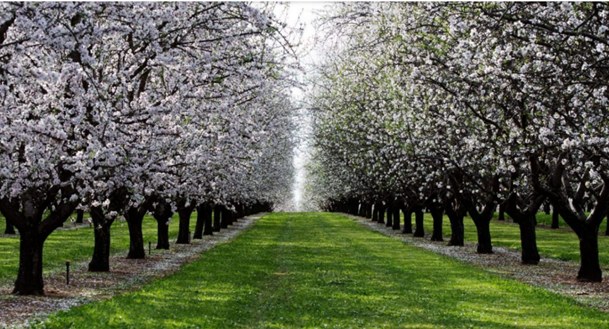
Almond grower and horticulturist in Renmark, South Australia, Jim Belehris, from Belehris Estate has plenty to say about PyroAg Wood Vinegar, having injected it into the orchid’s irrigation system for more than five years, the results are clear.
“The growth speed of the trees, their vibrant colour and quality of the nuts are great results which I have seen over the last five years. I am confident that PyroAg Wood Vinegar has played a pivotal role in the soil’s improvement. PyroAg Wood Vinegar is part of the all-important mix of strategies I use to create the ideal environment for the almond trees to grow well. I also use a lot of high-quality compost – not raw, microbes as well as molasses. Pesticides are not part of the equation at all which I am very proud of.
“Embracing sound and considered sustainable practices such as PyroAg Wood Vinegar gives me the leading edge in sustaining an orchard that is thriving. I have always had a mindset in looking for and discovering better horticultural practices.

Young and dynamic farmers creating sustainable change, one crop at a time

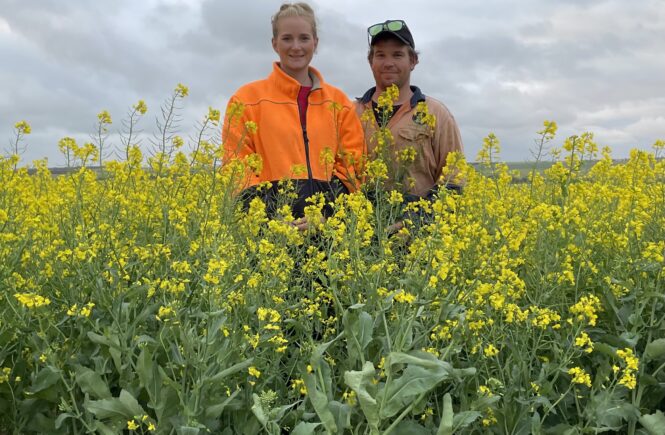
Miranda and James

For 32-year-old Miranda Pritchard and 34-year-old James Allen, their passion and commitment as
young and hard-working farmers shines through in their work ethic and commitment in succeeding
with their cereal farm in the Mallee.

And more than that, they are a dynamic duo who are committed in leading by example in
discovering and implementing smart agricultural choices to amplify their farm’s soil health.

With 2500 acres in the Mallee (1800 acres leased from James’s parents in 2018 and 711 acres
recently purchased), growing cereals lentils, canola, lupin beans, wheat and barley, James and
Miranda are talking the talk and walking the walk when it comes to minimising chemical
interferences and still run a profitable business.

Introducing PyroAg Wood Vinegar into the soil in late 2021 has been a significant turning point for
James and Miranda in the way they approach successful agricultural techniques.

“We decided to use a natural cocktail of PyroAg Wood Vinegar, kelp and BAM (Beneficial Anaerobic
Microbes) for our summertime weeding control and the results are clear,” James said.

“We have always been in the mindset in looking for sound alternatives that move against the tide of
mainstream agriculture.

“PyroAg Wood Vinegar is one of those answers.

“Miranda and I are confident that PyroAg Wood Vinegar plays a significant role in not only in the
soil’s health but also the greener canopies we are seeing in our trees across our farm.

“We use 50ml to a tonne in five litres of water mixture and we found that is the right combination to
get the results we want.

“We have used PyroAg Wood Vinegar a number of times in the last seven months as we steer away
from chemical insecticides and fungicides.

“While we are still young farmers, our mission is clear.

“We want to set the foundations for our five-year-old son, Jack, a next generation farmer, to have
the best chance of success with the healthiest soil possible.

“Products like PyroAg are the only ways in moving forward with a clear conscience that is also
profitable and sustainable.”

Cereal and legume farm – Surrey Brae – Yorke Peninsula, South Australia

For 4 th and 5th generation cereal and legume farmer, Chris Routley and son Nick, tending and
managing their 4000-acre farm is serious business.
Surrey Brae in the York Peninsula, South Australia, and is known for growing wheat, barley,
chickpeas and lentils and is set on a farm that is 102 years old.
And for Chris, the health of the soil is of number one importance.
Chris has always used a range of pesticides and fertilisers to keep pests away and to maintain soil
health.
But it is one key ingredient which Chris introduced in 2016 which has created a significant difference
to the quality and health of the soil. And that is PyroAg Wood Vinegar.
“PyroAg Wood Vinegar is applied at a rate of two liters winter and three liters summer of PyroAg per
1000 liters of water. PyroAg is also used to lower the pH in water from 8.2 to 6.2 and we are now
reducing our chemical up to 20 per cent,” Chris said.
“I have noticed healthier crops as well as there is a better kill on the weeds which is another bonus.
“Every year, I use 5000 liters of PyroAg Wood Vinegar often spraying part of the farm eight times a
year.
“This was the first time I dipped my toe into regenerative farming, and I have not looked back. I
clearly see the benefits of PyroAg Wood Vinegar with not only the crops but also on the seeds as
well.
“I use PyroAg Wood Vinegar as a seed dressing 50ml per ton plus 2Lt of zinc 24 hours prior to
seeding and I am finding it acts as an accelerator, allowing the seeds to absorb the fertilizer more
quickly and with improved regrowth.
“It is also very reasonably price and that is an important part of the equation in the industry I am in.
“I would highly recommend farmers invest in PyroAg Wood Vinegar as it is an investment for your
farm as you reap the benefits in the short term and long term.”

Photograph names – Left to right
L to R Harry (6th gen) with Nick (5th gen) my father Robin (3rd gen ) Myself (4th gen) with
Hudson(6th gen)