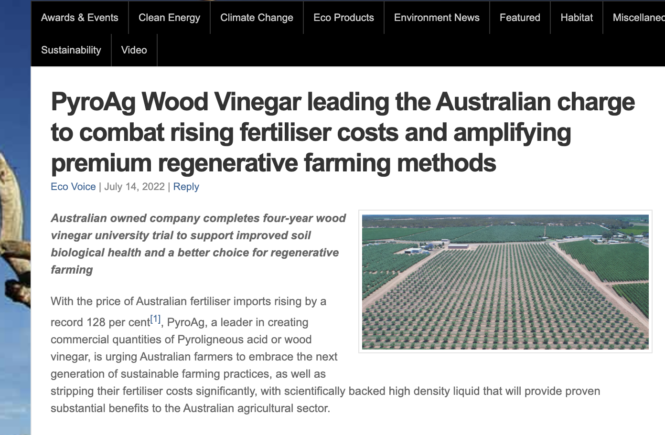

Paddy rice growers investigating soil health inputs will find a useful reference point in research published in the Korean Journal of Crop Science, which examined how wood vinegar application affected soil chemical properties and rice growth when combined with rhizosphere microorganisms and fertiliser.
The pot trial tested four factors simultaneously — two soil types, three fertiliser rates, three microorganism types, and two wood vinegar application rates (500x and 1000x dilution) — across 54 treatment combinations. The comprehensive design makes it one of the more thorough examinations of wood vinegar under varying soil and input conditions.
On soil chemistry, wood vinegar at 500x dilution resulted in higher residual total nitrogen in soil compared to untreated controls, regardless of fertiliser level. Slight increases in exchangeable potassium, calcium, and magnesium were also observed with wood vinegar application, particularly at 500x dilution combined with full fertiliser rates. Organic matter levels also showed a slight upward trend with wood vinegar application across different fertiliser rates.
On rice growth and yield, the study found that fertiliser application rate and soil type were the dominant factors — effects that were strong enough to mask contributions from both microbial inoculation and wood vinegar across most growth parameters. The authors note this was partly a consequence of the pot experiment design, where no leaching occurred and nutrient availability was therefore higher than typical field conditions. They explicitly caution that the absence of significant wood vinegar effects on yield under these specific conditions should not be interpreted as evidence against potential benefits, particularly under long-term or field application scenarios.
For Australian rice growers, the soil nutrient findings are the most practically relevant. The research indicates wood vinegar may improve the availability of nitrogen, potassium, calcium, magnesium, phosphorus, and organic matter in paddy soil — potentially supporting soil quality over repeated applications. The authors conclude that further field-based research is needed to fully evaluate these benefits under conditions more representative of commercial production.
This is a peer-reviewed study published in 2015, and its honest reporting of both positive and null findings makes it a credible reference for growers evaluating wood vinegar as a soil health input rather than a standalone yield booster.
Source: Effects of Rhizosphere Microorganisms and Wood Vinegar Mixtures on Rice Growth and Soil Properties — Jeong et al., Korean Journal of Crop Science, 60(3), 2015 (https://dx.doi.org/10.7740/kjcs.2015.60.3.355)
Interested in learning more about wood vinegar? Order PyroAg now (https://www.pyroag.com/shop/PyroAg-c168051794) or call 1800 PYROAG (1800 796 224).